This project was a wonderful opportunity spearheaded by our local regional gallery, Rockhampton Museum of Art, involving responding to one of the works in their extensive collection. Twenty Capricornia Printmakers members participated in RMOA’s 2023 Artist in Residence program responding to 17 items from the RMOA collection (prints, paintings, ceramics, etc.). The exhibition was held between 24 February – 25 August 2024.

I pulled together these answers for a high school student who was responding to the art work while it was in the gallery. It is a nice peek inside the machinations of my mind as I approached the piece.
1. What inspired the initial idea for your artwork, and what themes or concepts influenced you?
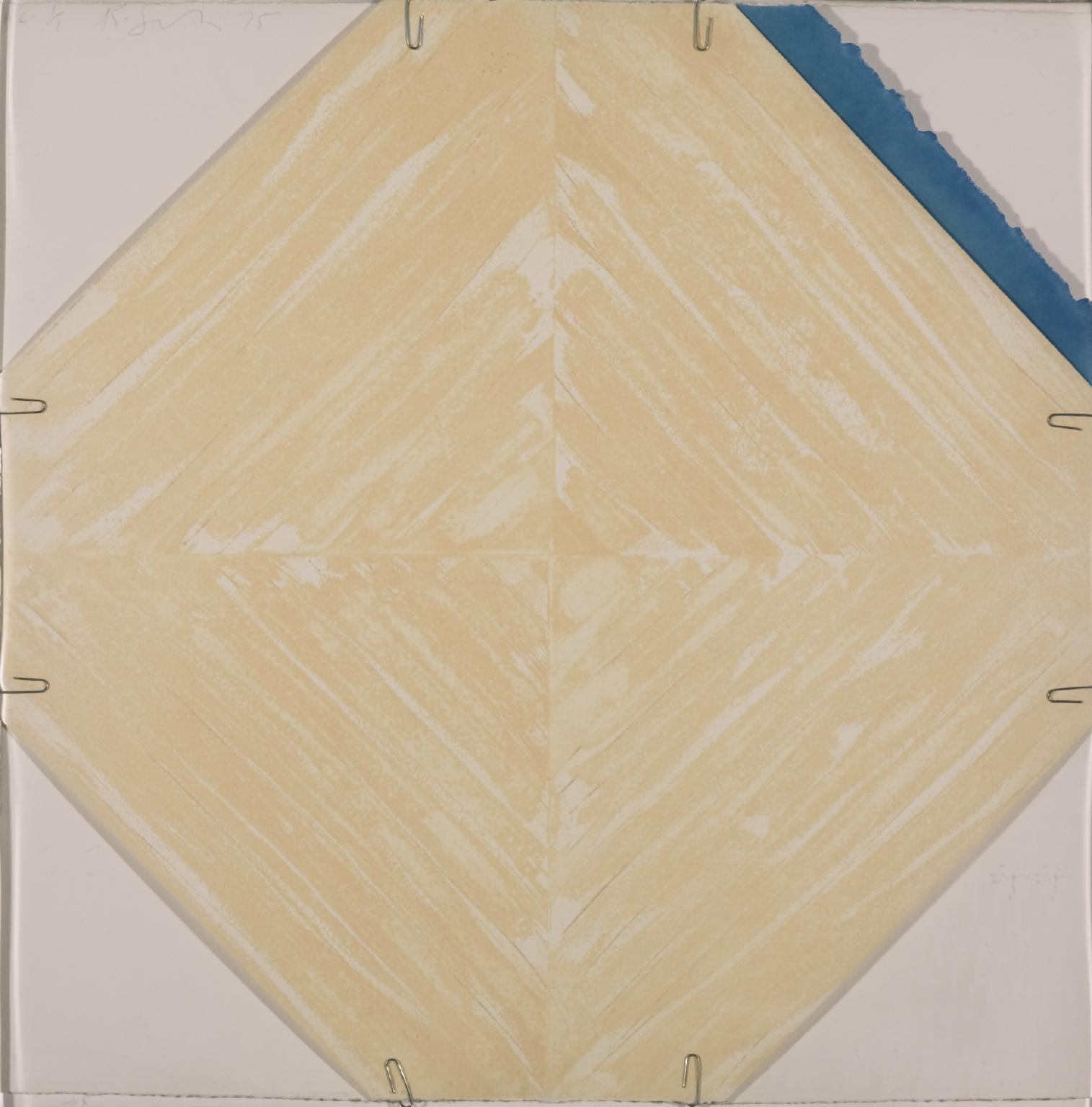
As mentioned when the project started, I was responding to Richard Smith’s Paper Clip Suite II, 4 (1974). Here is a similar one in the Tate Collection:
When we looked at the 50 or so stimulus pieces, I was drawn to shapes that resonated with quilt blocks. I am a quilter of over 25 years experience, and design and sell patterns, often with a history of the traditional block I have used; so, I have a huge visual lexicon in that field.
I chose Smith’s piece in the end because the central yellow lithograph reminded me of a ‘log cabin’ quilt block and I was drawn to his folded and layered edges. I felt it had lots of jumping off points.
This is what I wrote for the catalogue:
With my background in textiles, I was immediately drawn to Richard Smith’s work. I was excited by his use of simple etchings on squares to create geometric shapes; which reminded me of log cabin-style quilting squares. Smith also folds the paper to achieve this, which is a quintessential textile process. The paperclips also add a collage element.
2. Can you describe your creative process from the moment you had the idea to the final piece?
First stop was to do some research on the artist. I noted that he had other pieces that he had tied some works, rather than use paperclips.
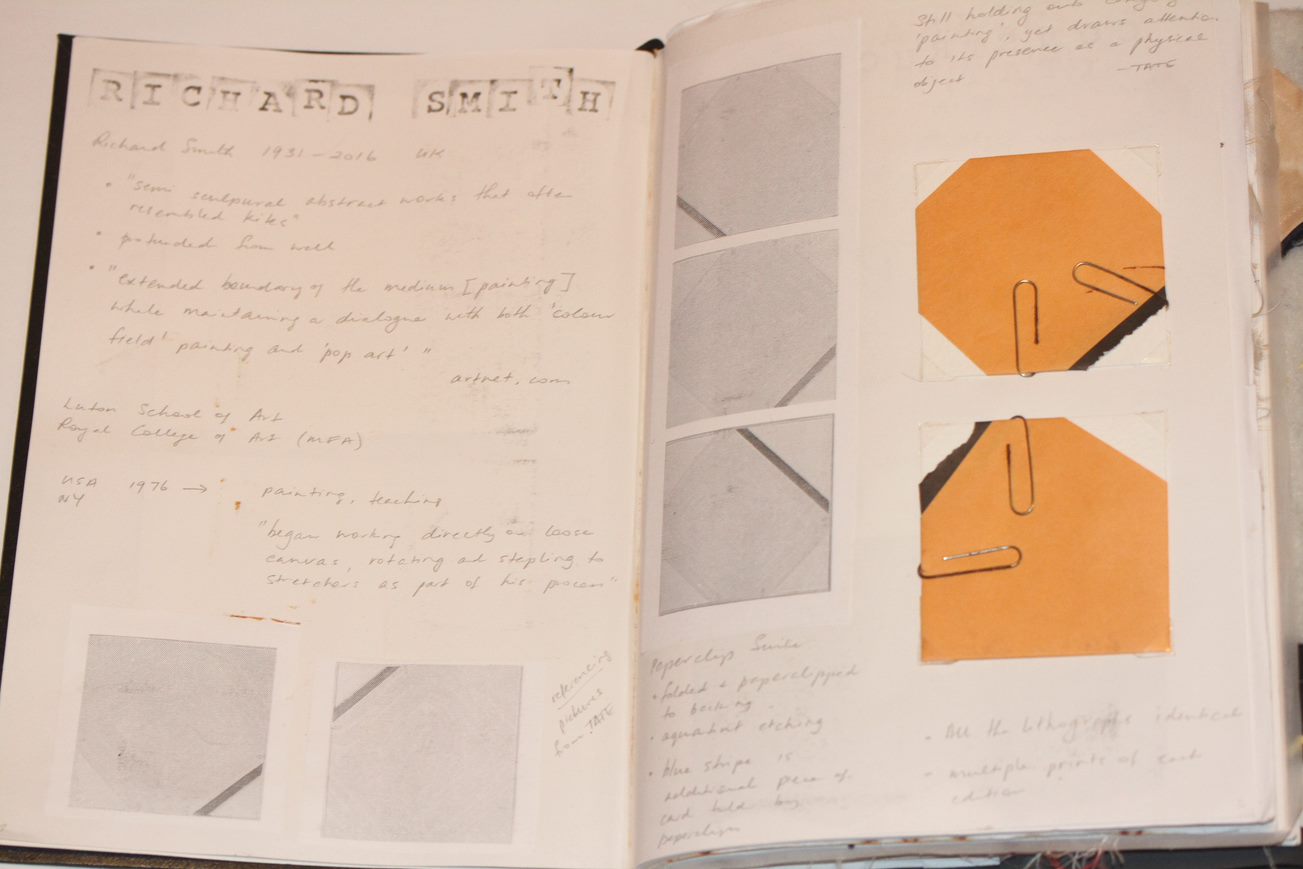
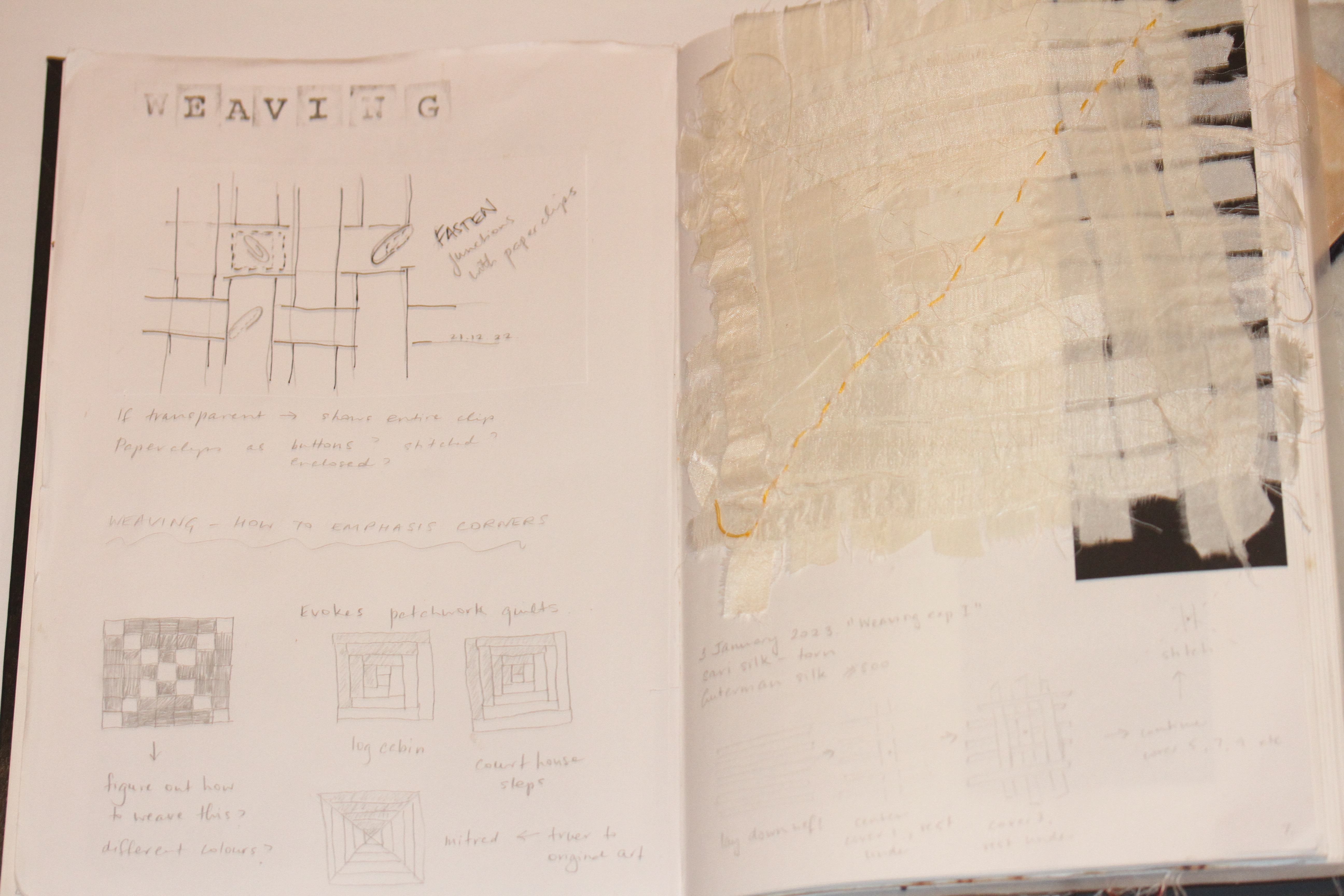
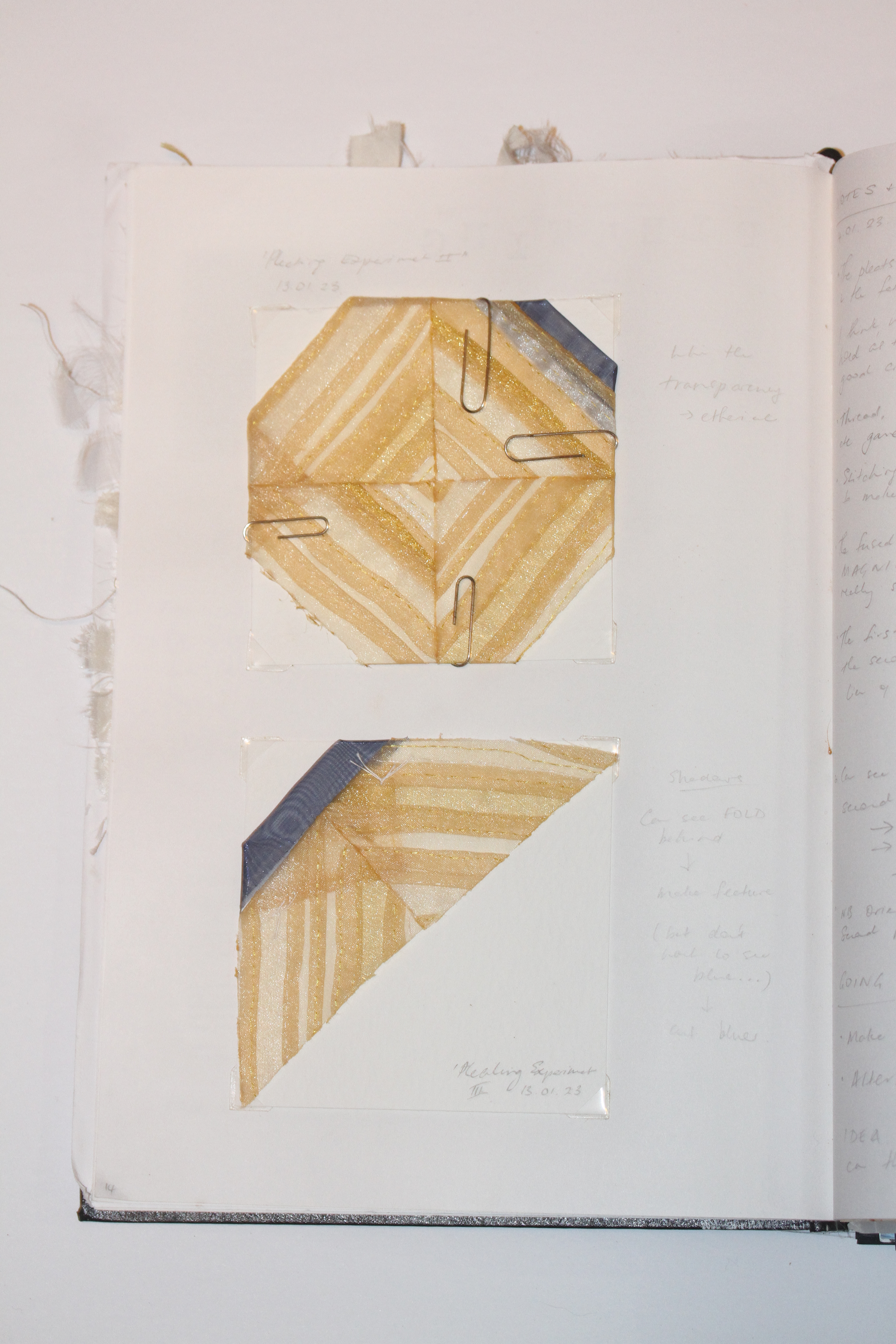
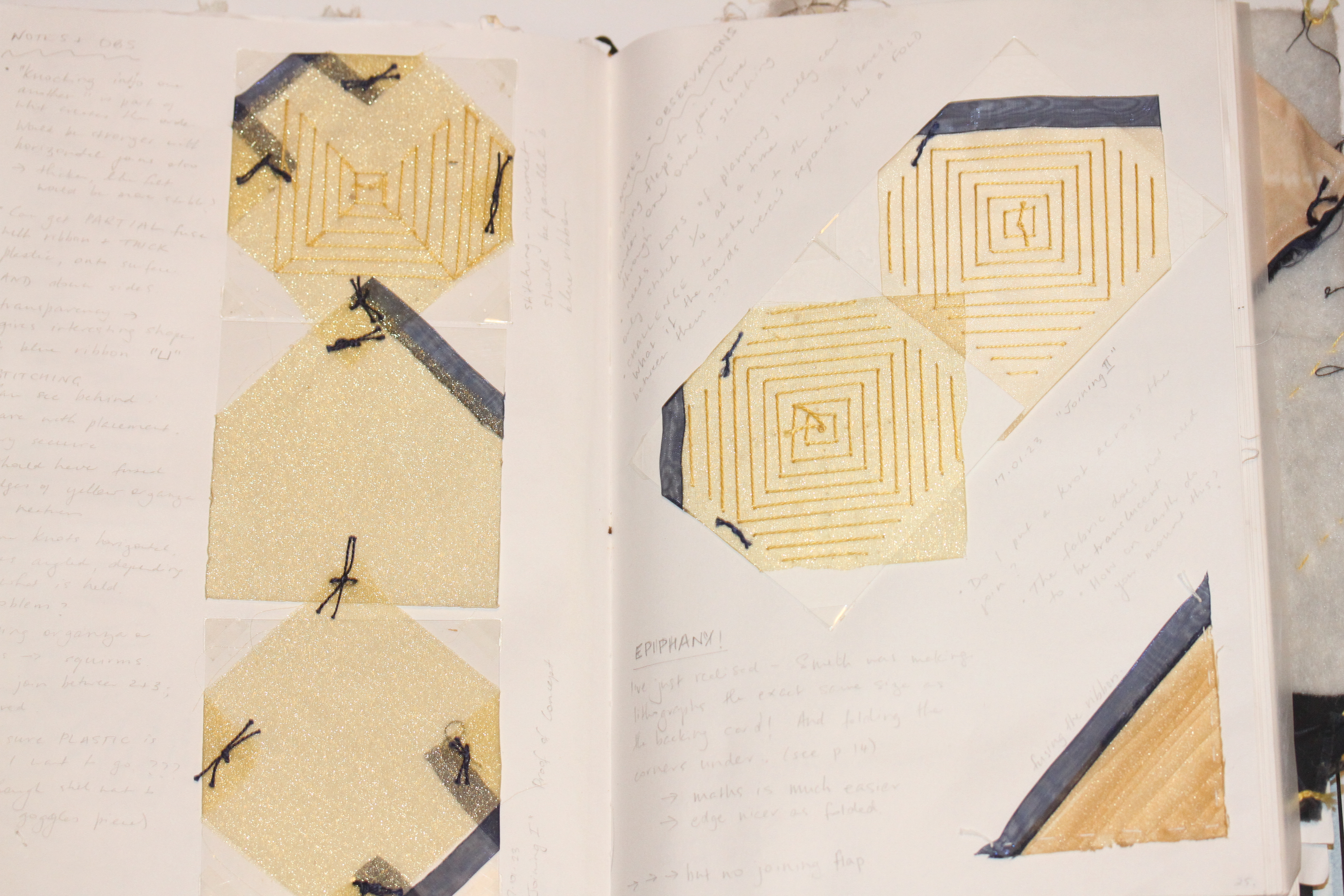
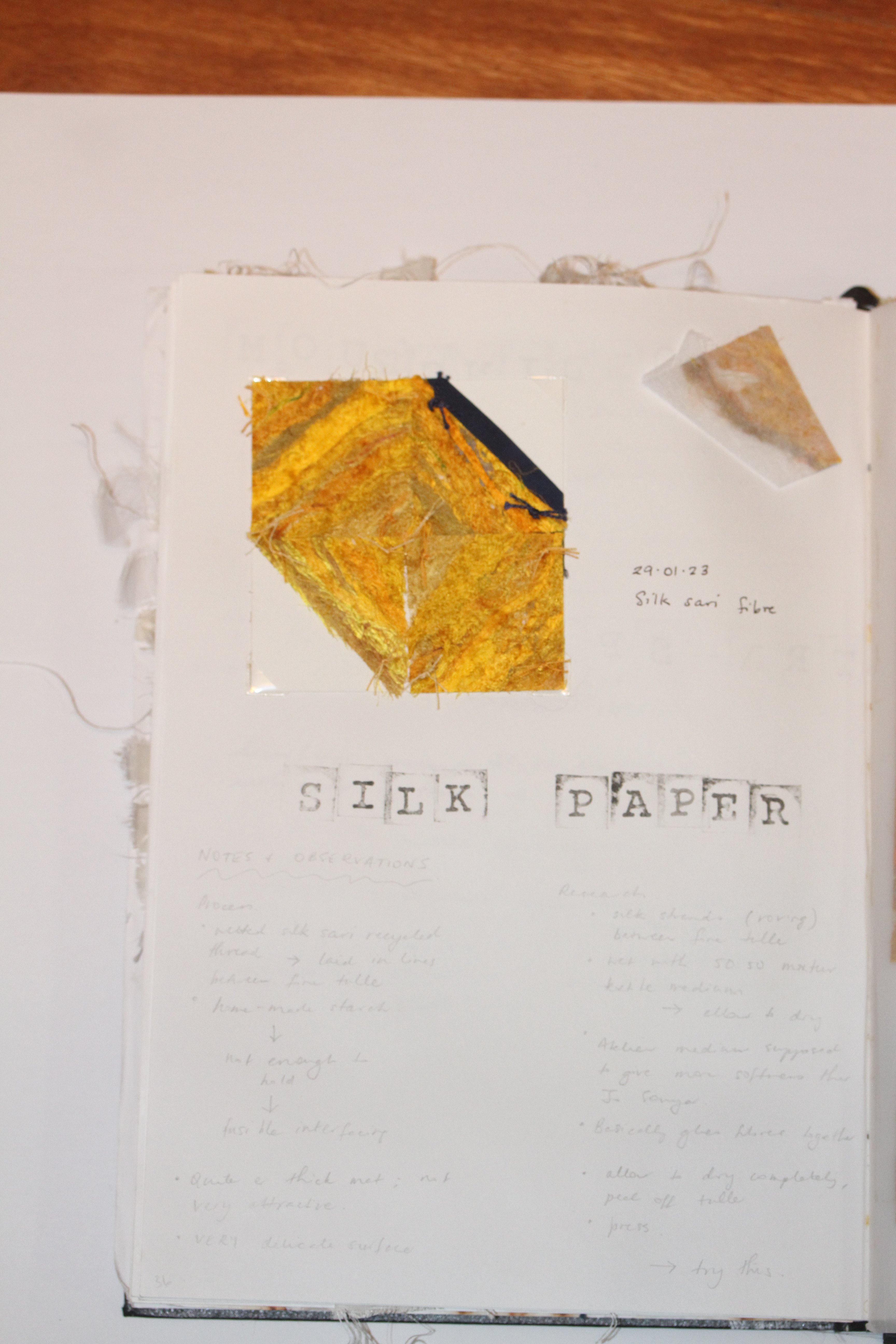
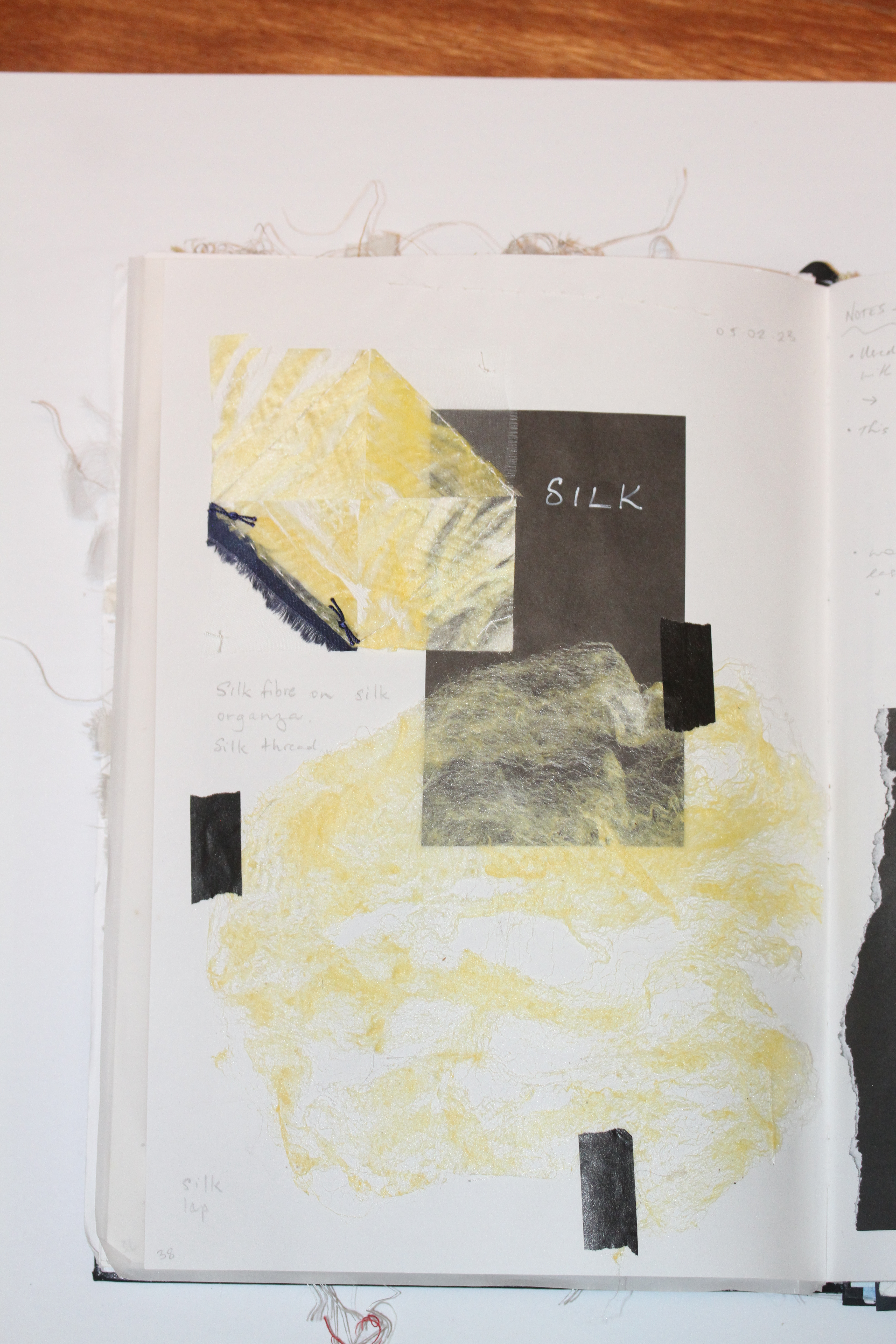
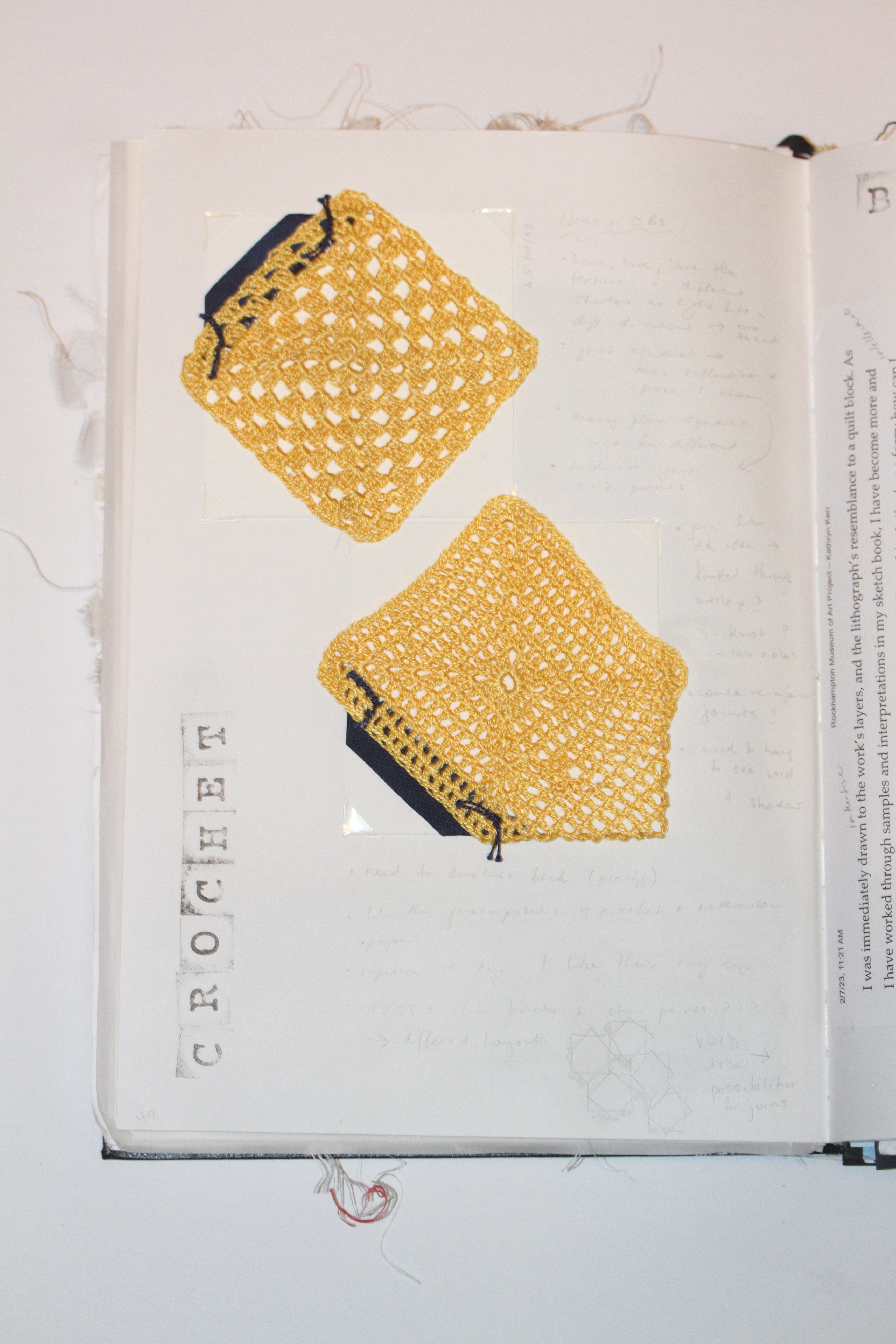
In general, I brainstorm lots of ideas in the first instance. I allowed myself several months to make small samples from the ideas, then assess the work, and continue to develop with new ideas and samples. You can see from the journal pages that I covered a lot of ground!
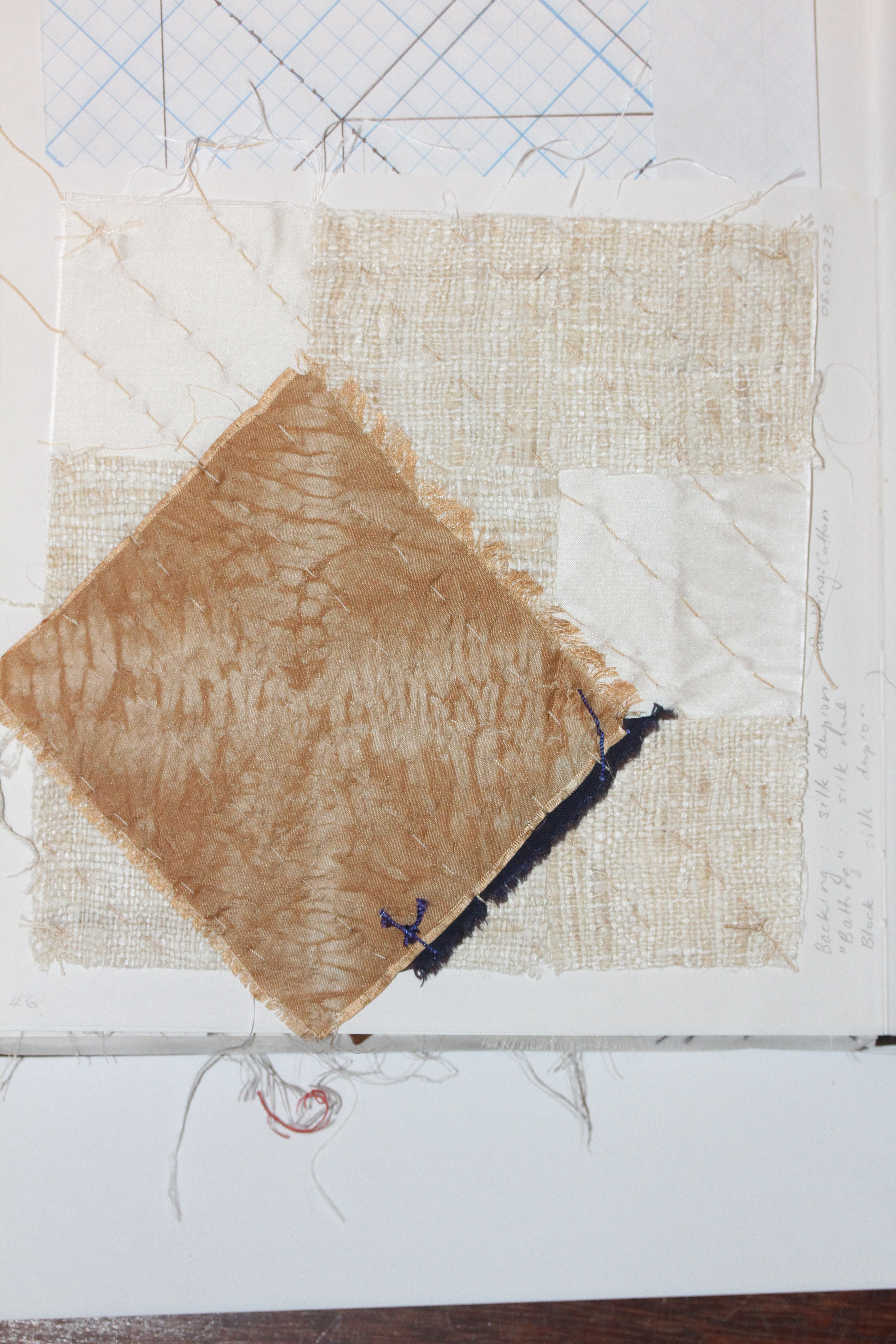
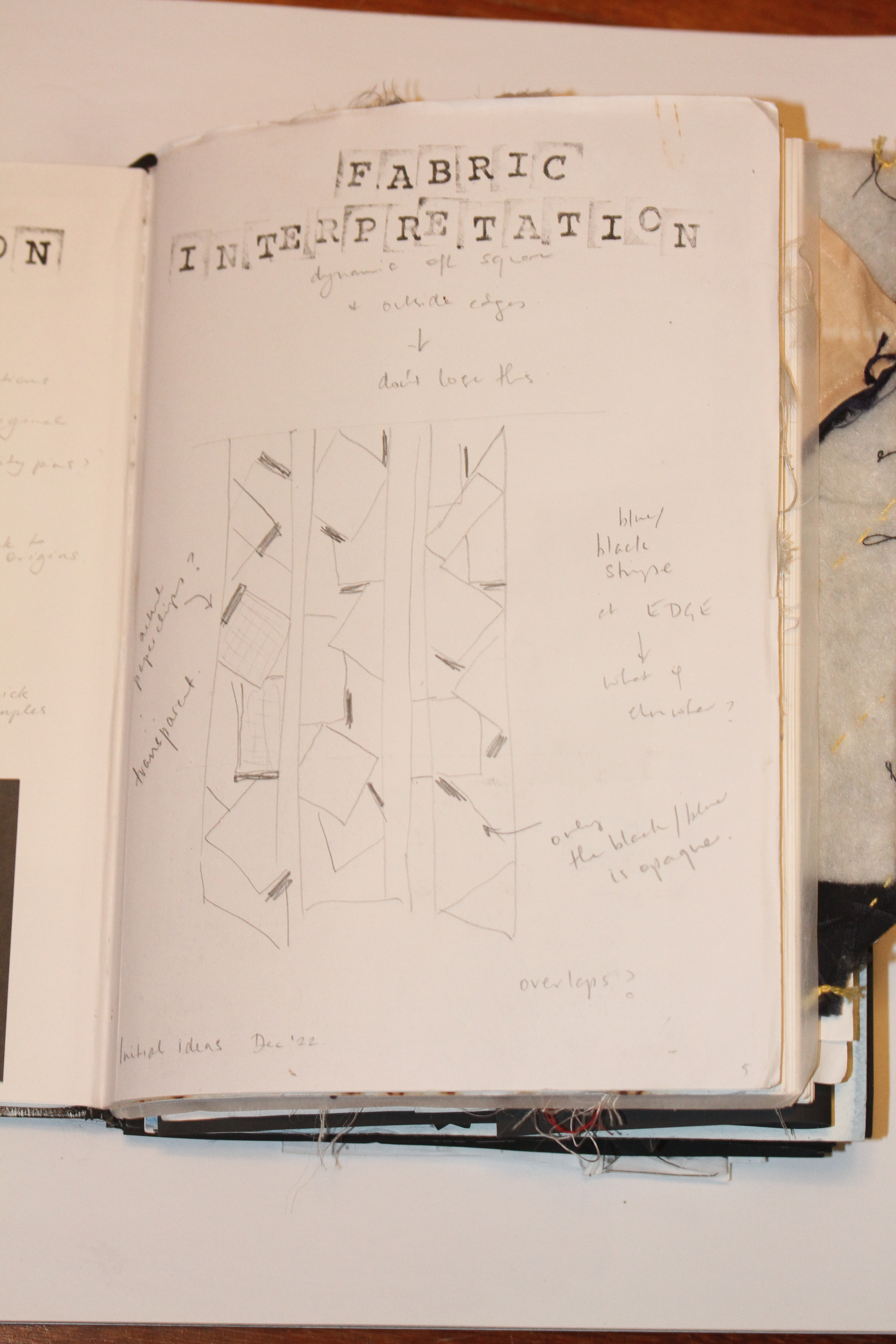
Initially I stuck close to the stimulus piece, but experimented with different media within the compass of textiles: paper, cloth, etc.
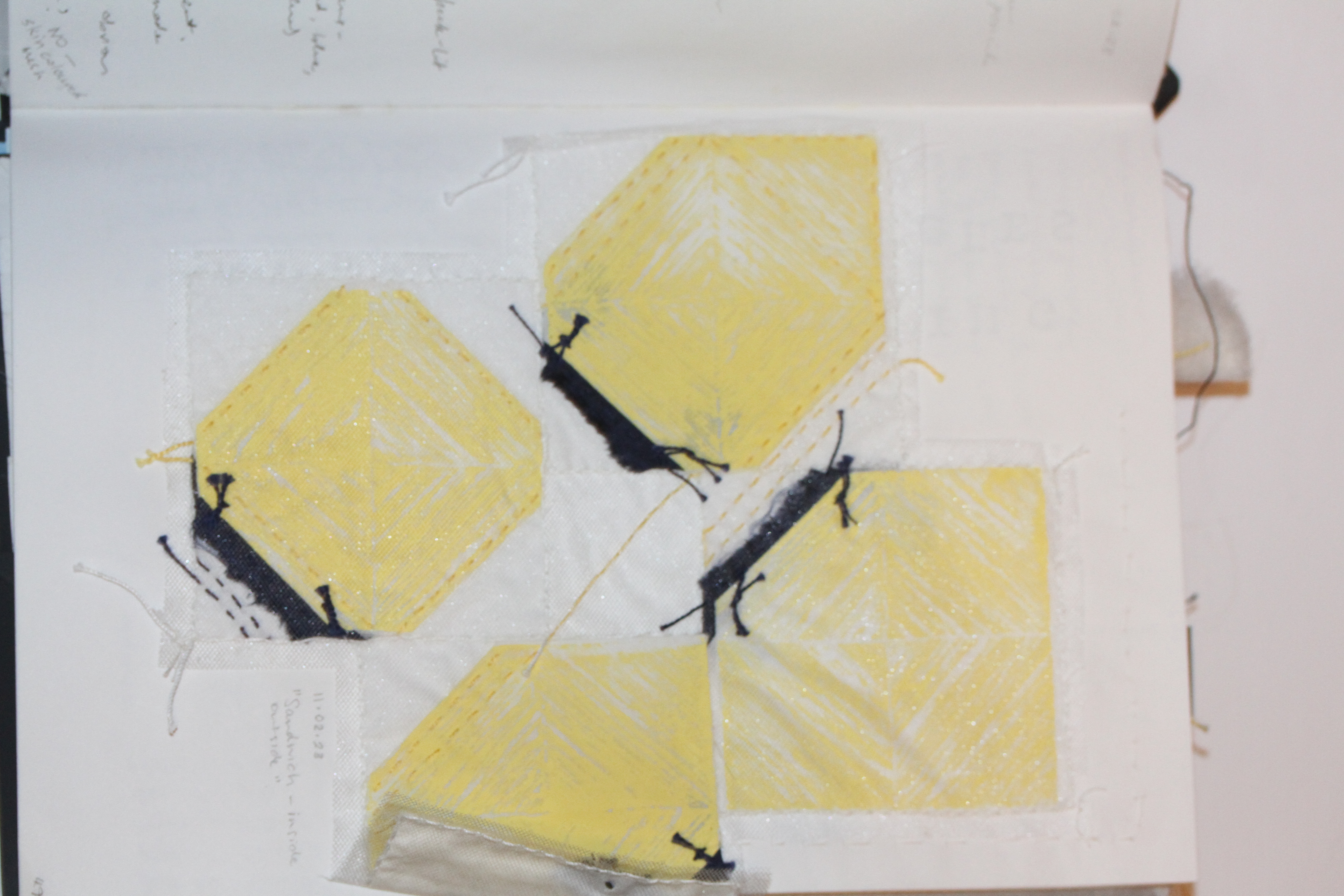
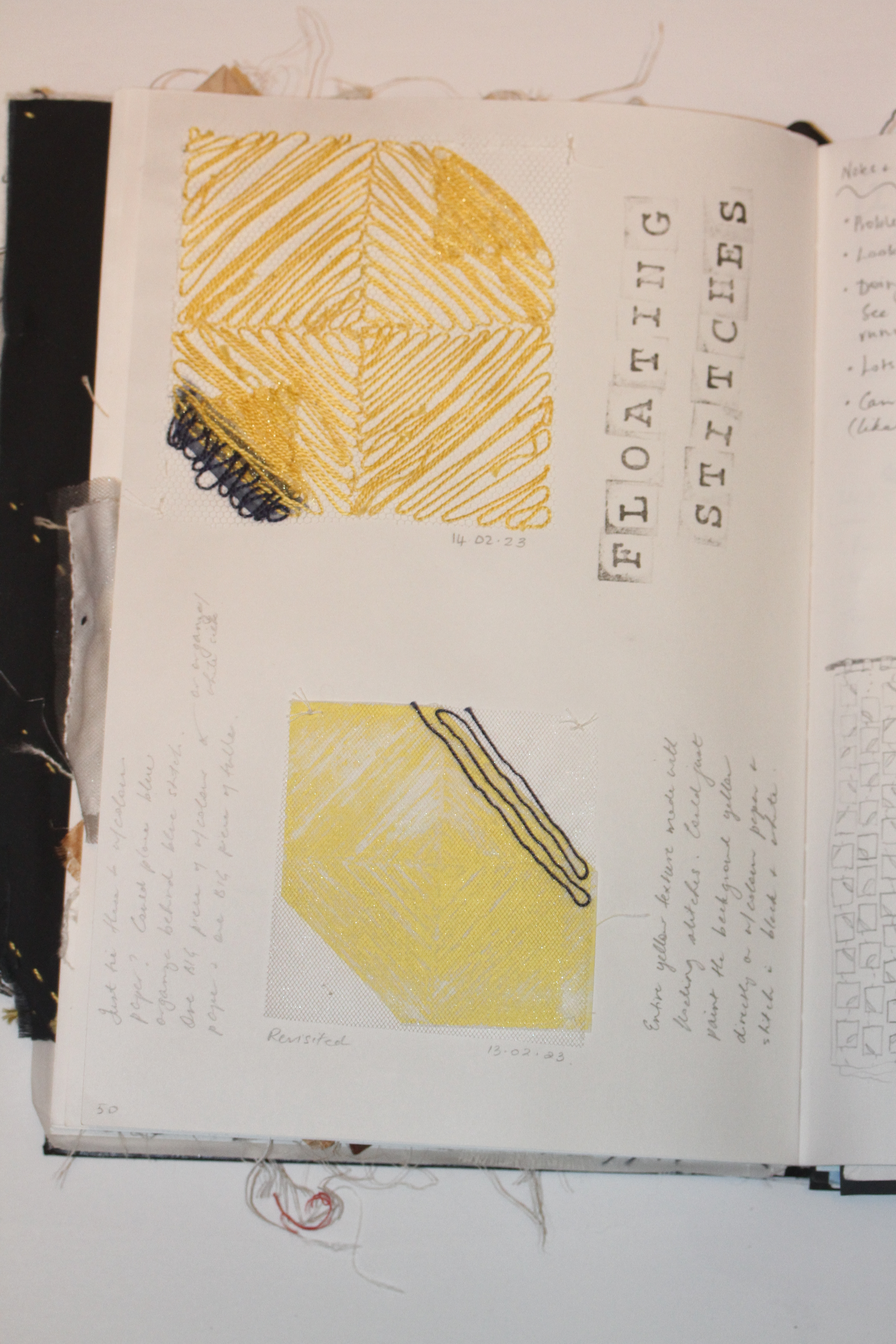
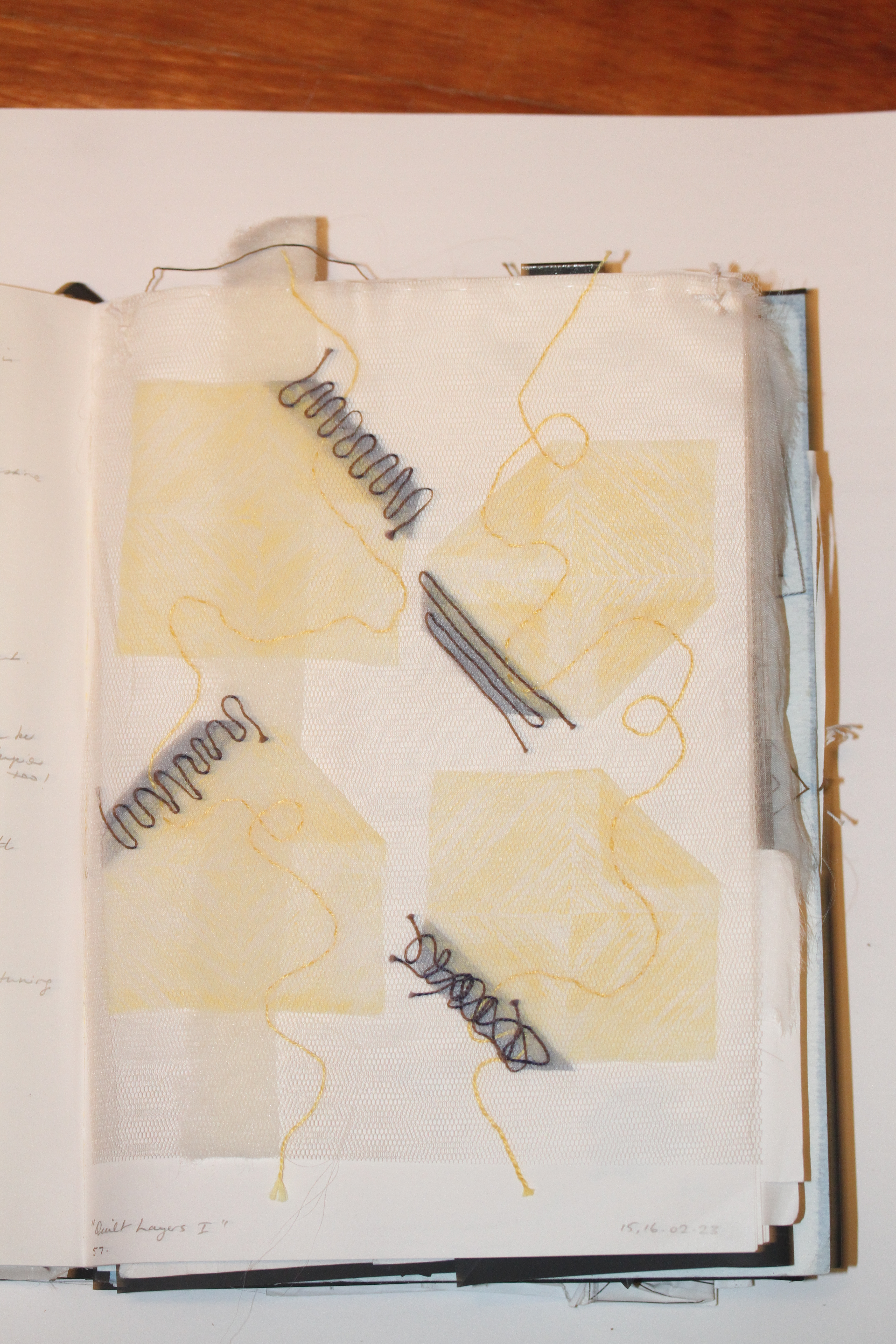
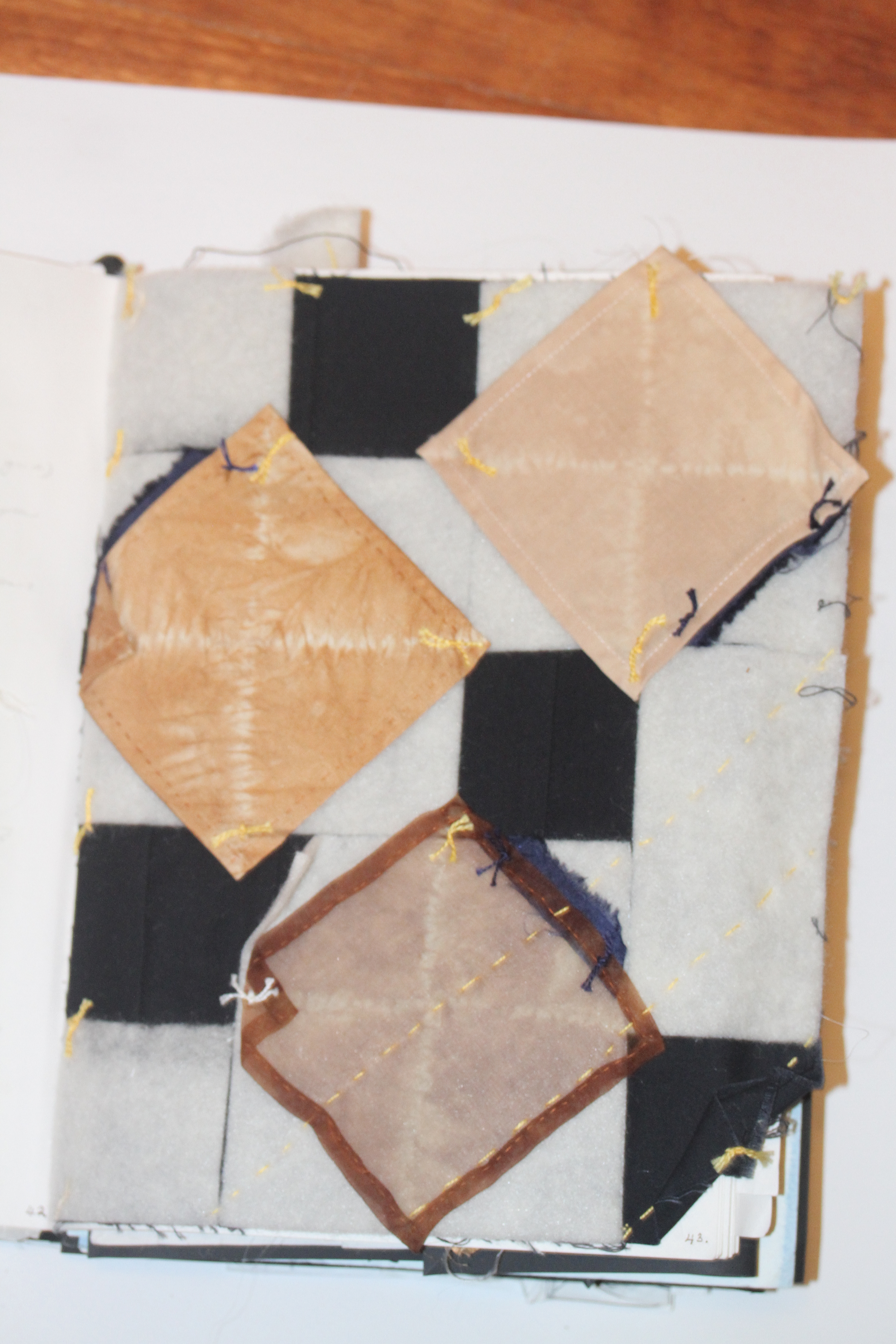
3. Were there any specific experiences or moments that sparked the vision for this artwork?
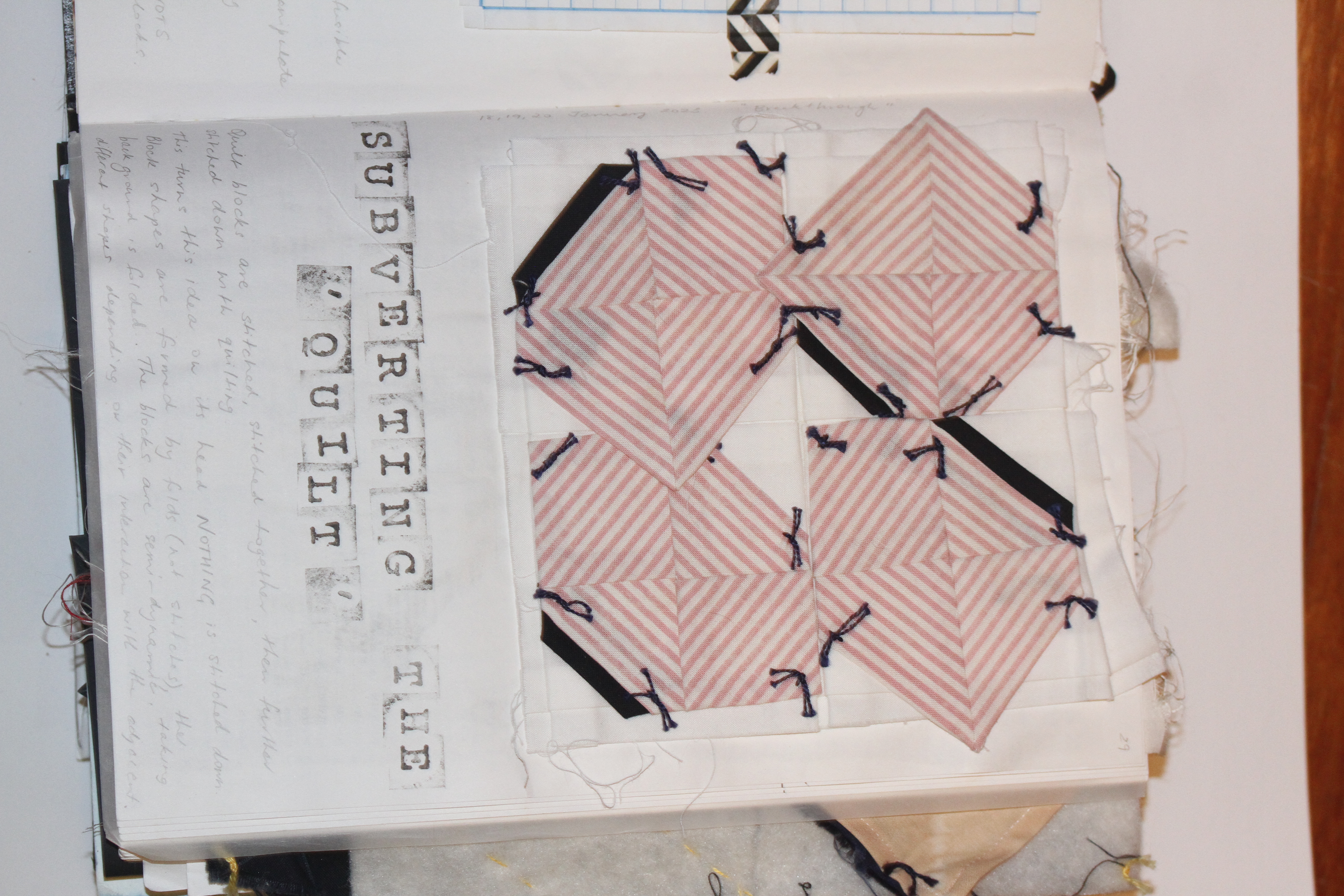
When I made a couple of samples on fabric, I experimented with folding with a view to making a hanging textile piece.
A lightbulb moment. Folding! This didn’t need to be two dimensional!

4. How did you choose the materials and techniques to bring your idea to life?
There is a real feedback between the media and the idea. The media always guides the idea. Once I chose to ‘fold’ then I started exploring stiffer media: stiffening fabric, a plastic ground onto which I could stitch, card, paper, etc. Manipulating the media reveals new branches to explore.
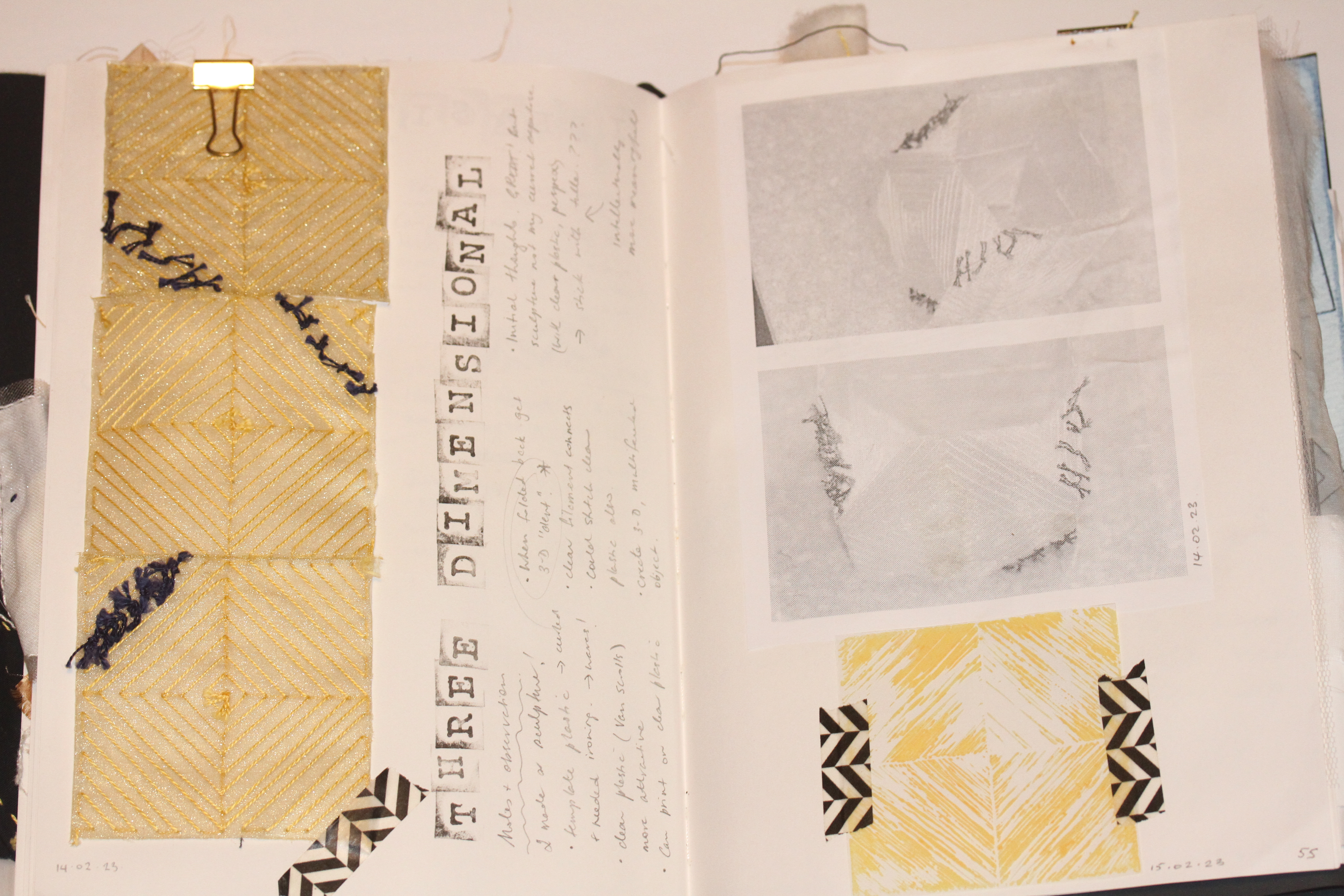
This is the start of folding paper. I tried to make a ‘log cabin’ in 3D.
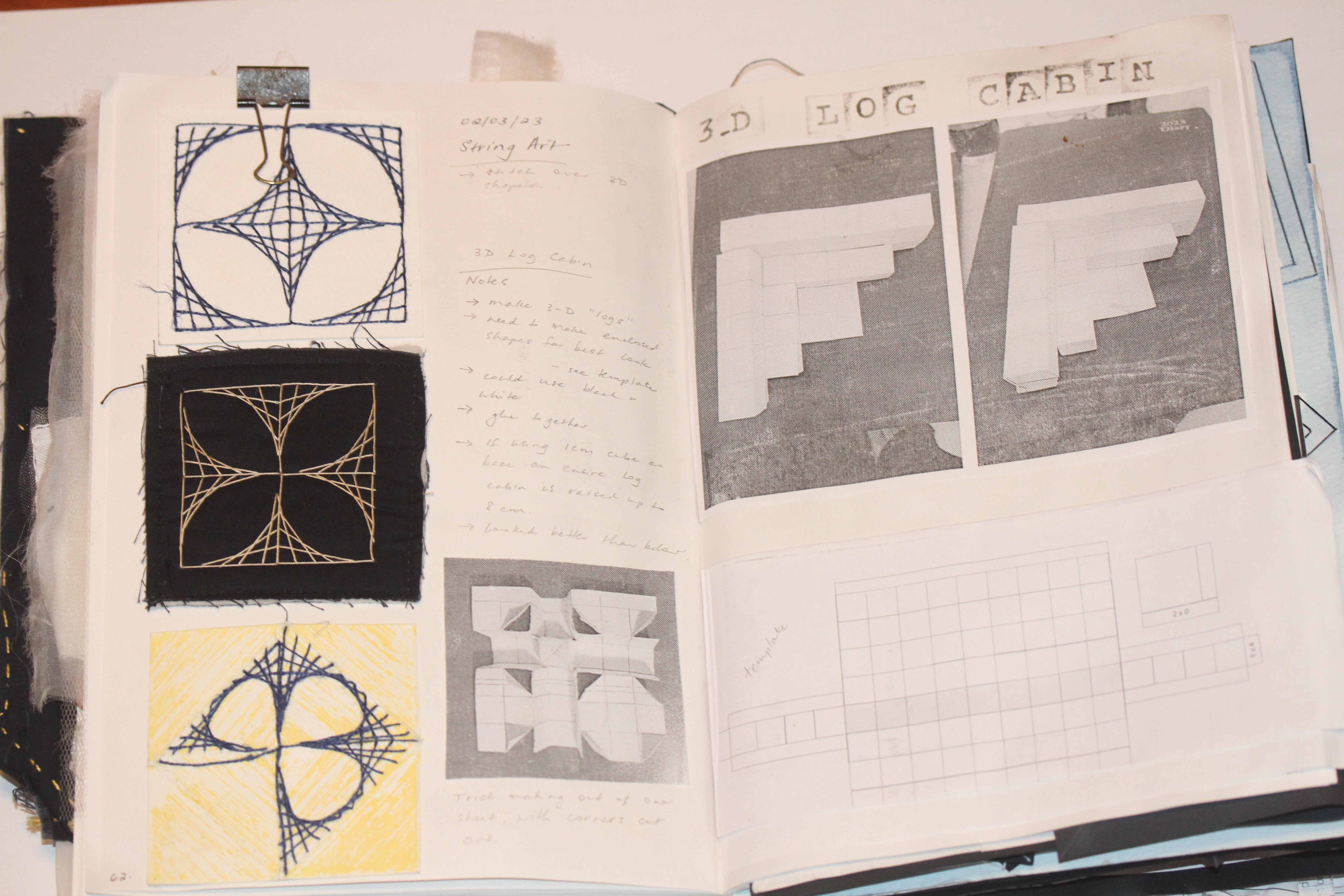
It was only when I discovered the ‘hypar’ that I realised I had something really fascinating.
In my process, I discovered the ‘hypar’, the name given by mathematicians to a three-dimensional parabolic shape formed by folding flat paper in concentric squares.
Here are some ‘hypar iterations’ samples (some were 3D, but got squashed in my journal):
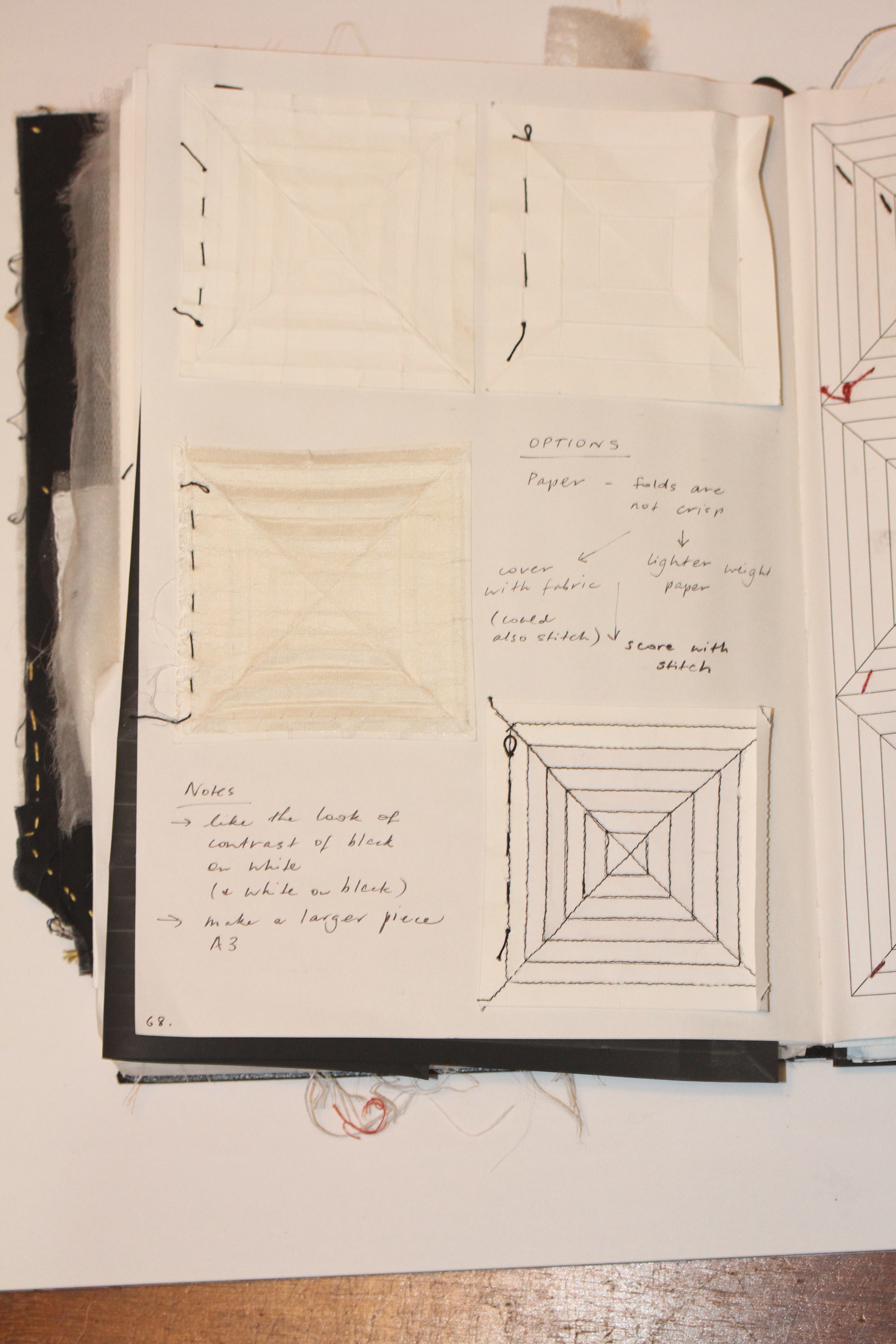
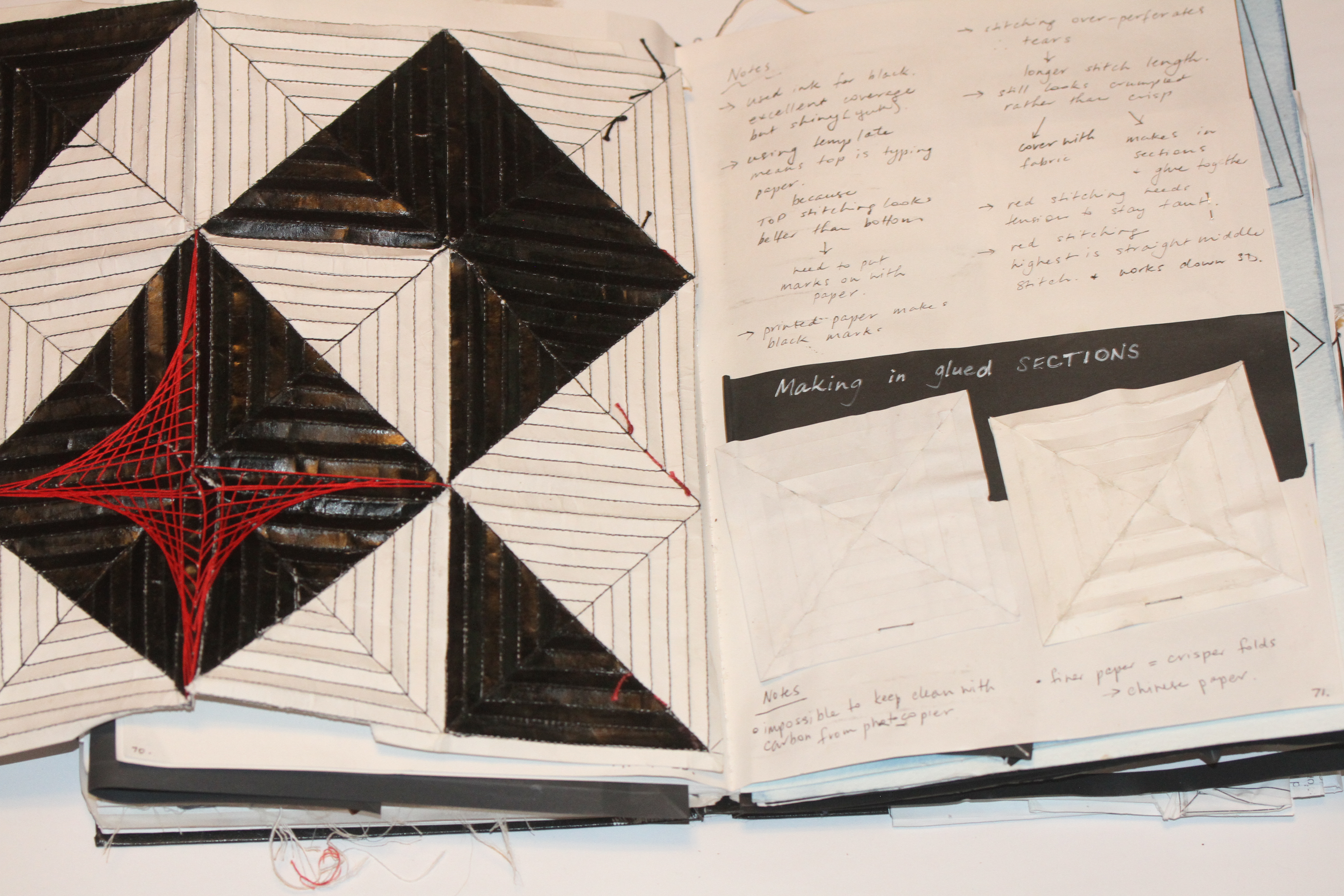
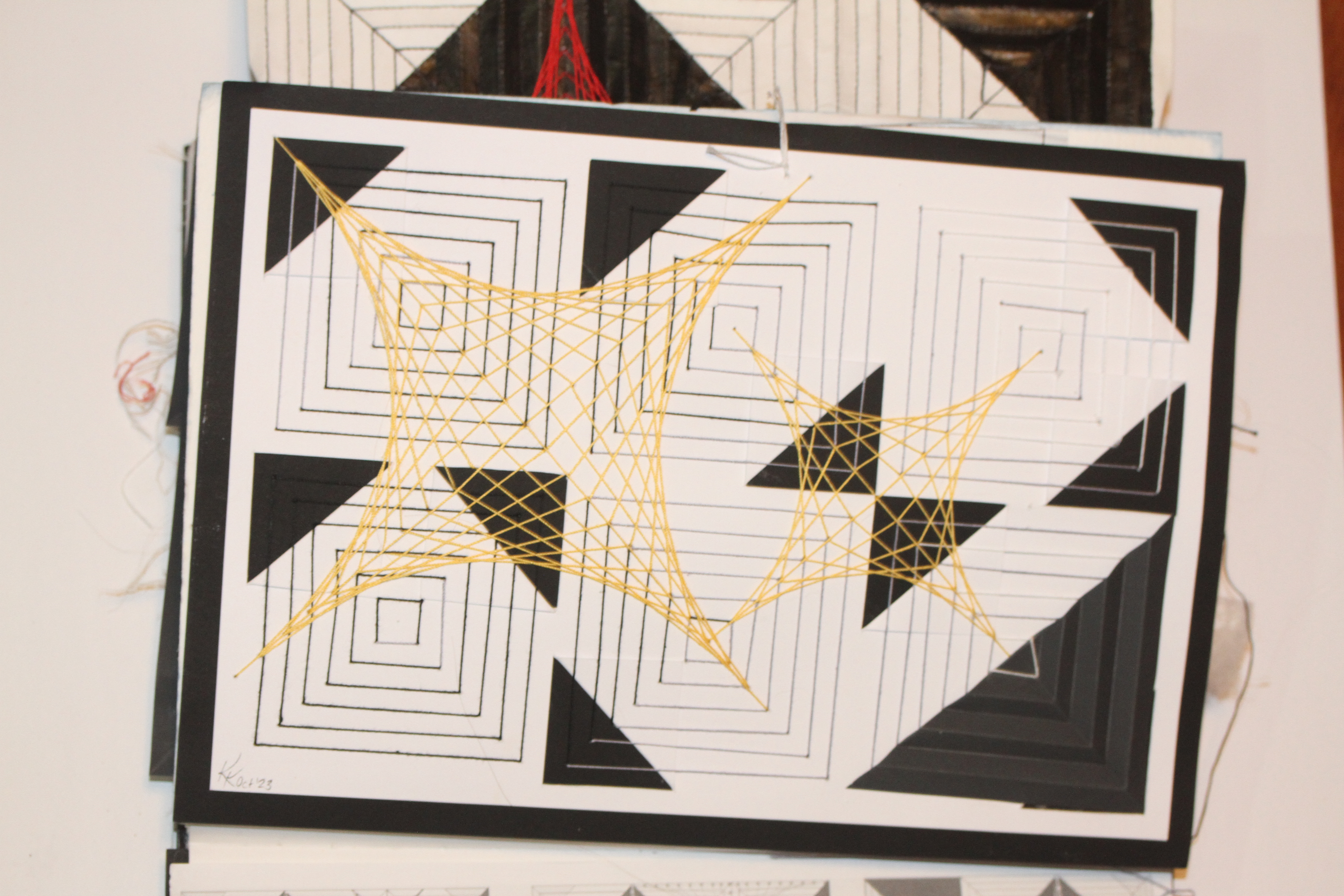
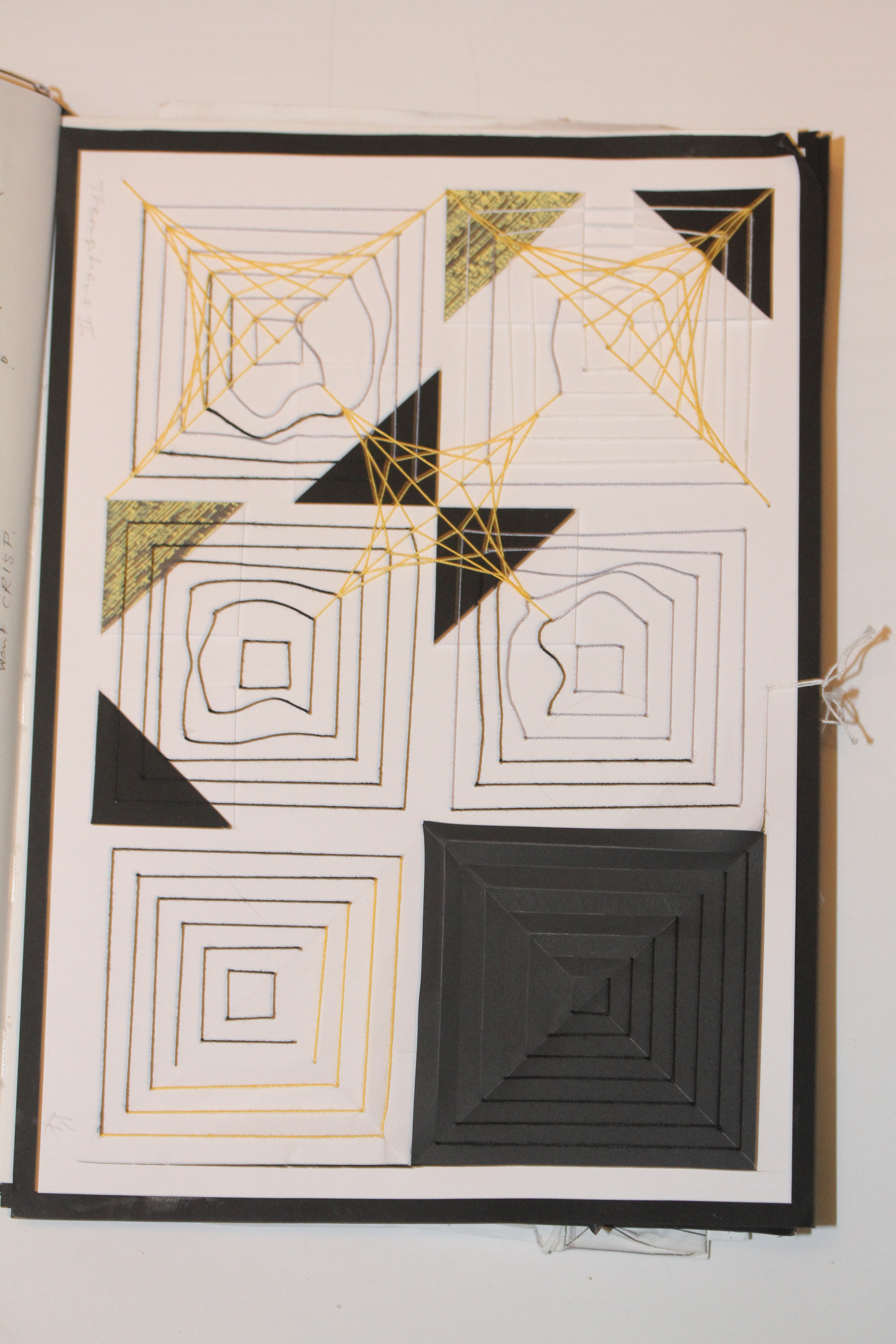
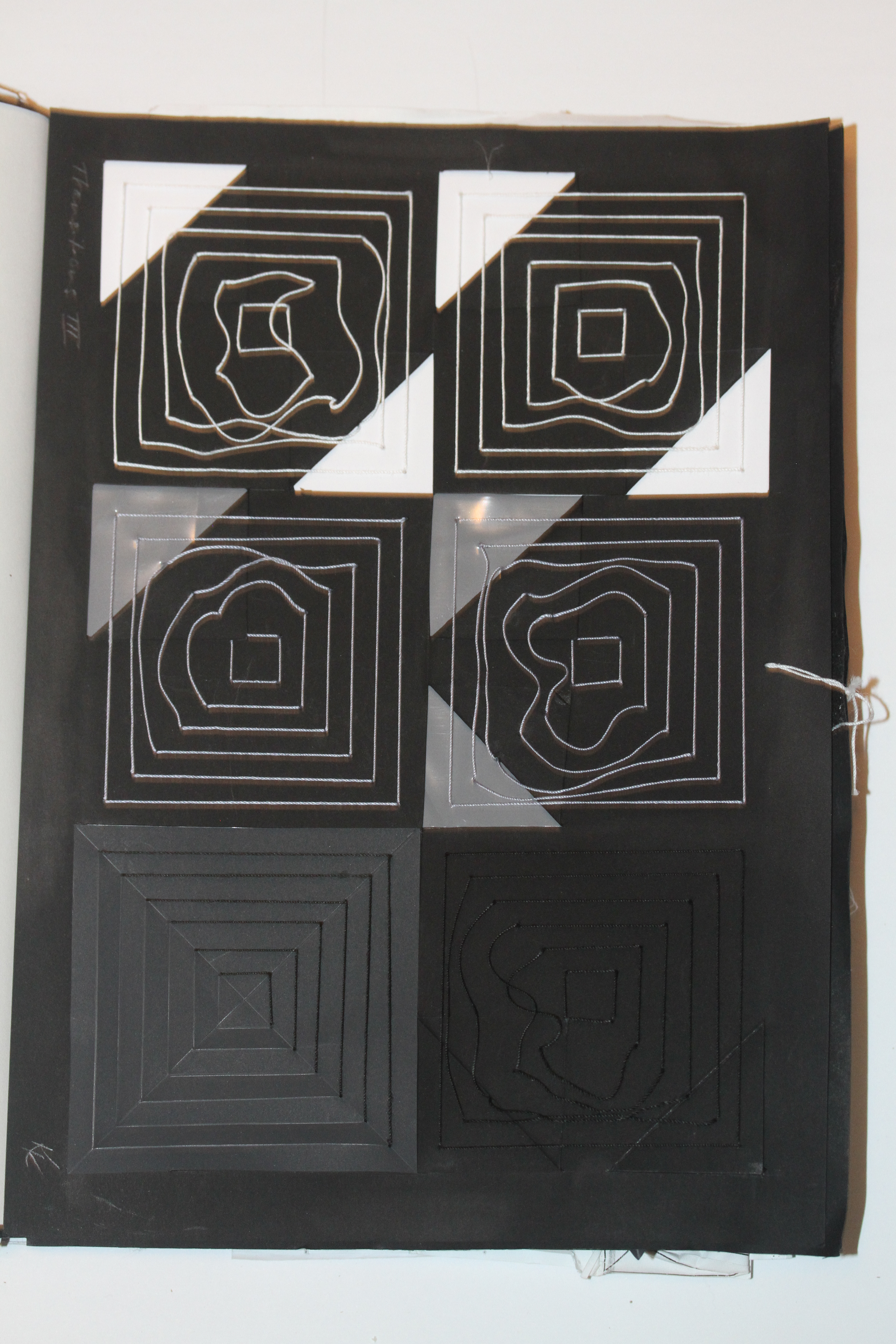
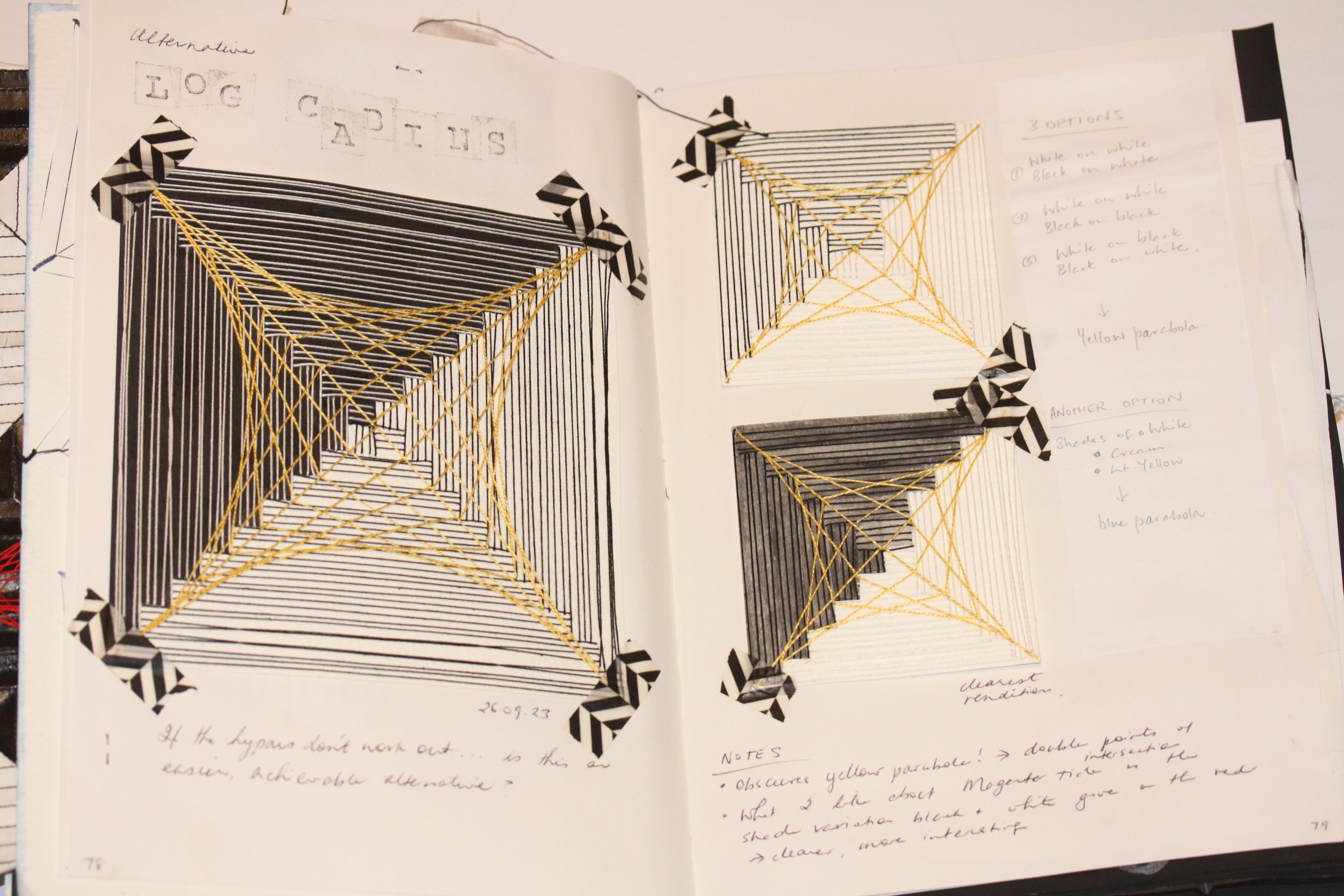
5. Did you encounter any challenges during the creation process, and how did you overcome them?
Every sample is a challenge! In my journal, I assess each piece under the broad headings: pros, cons, ideas/going forward, notes. I can take a step back, consider what is pleasing to me (design and composition considerations), how the technique could be improved if I were to make this again, how the materials behaved, as well as capturing ideas and notes.
It is an iterative process.
I also set myself the challenge of holding the entire work together only with stitch. There is no glue, tape, staples, etc, only stitch. When it came to presenting the final work, which was small pieces of synthetic paper stitched to a black sheet, I had decided to stitch it to a more rigid backing. First I tried black acoustic board – still too wobbly! Finally I stitched it to a stretch canvas through existing holes in the piece all the way around the edge.
6. How do you feel your personal experiences or background have shaped the idea behind this artwork?
It wasn’t until I had completed the piece that I stood back and said, “That’s just a quilt!”. To me, it read a lot like a ‘medallion quilt’ with blocks in concentric squares. Without knowing it, my experiences had shaped the entire thing!
7. Did you reference any other artists, styles, or artworks while developing your concept?
Once I started folding, I discovered the name of my 3D object: ‘hypar’. I downloaded a couple of maths papers and maths teaching papers – I was a scientist and a teacher in previous lives.
On the internet, I looked for other artists folding paper and discovered the amazing Matthew Shilan. On his website he references a book ‘Folding Techniques for Designers’ by Paul Jackson (2011). I bought a copy and gobbled up every page; it was opening a whole new world for me.
But I also knew that rather than cut and glue pieces, like Matthew Shilan, I wanted my work to be held together entirely with stitch.
Since I wrote this, I have also discovered Richard Sweeney‘s incredible paper sculptures.
8. How did you decide on the composition and overall design of your piece?
My samples had all been A4 size, so I knew I wanted to use a bigger scale. I had experimented with pieces jutting to varying degrees. So, it seemed intuitive to make the folds larger and larger from the centre out. Hence its name: ‘Unfolding’.
More specifically, for the final piece. I made a one quarter mock up so that I could really get a handle on the process (then photoshopped it to show how it would be when it was finished). I discovered that there were an uneven number of rows and columns, which meant the ‘flow’ of the hypars from high edge to low edge would be interrupted. I overcame this by making the centre rows/columns different.
9. What was your intention behind this artwork, and how do you hope viewers will interpret it?
My intention was to interpret Smith’s piece in way that felt authentic to me. It was the design/sampling/reflection process that led me from a fairly traditional hanging textile to stitched paper.
10. Looking back at the creation process, is there anything you would do differently if you were to revisit this artwork?
There are plenty of composition and design problems to solve, as well as technical ones. I already have the next artwork designed! The next piece will be stitched directly to a canvas (black canvas 1.2m x 1.8m). This will bypass the entire step of having an intermediate black paper ground.

copyright Kathryn Kerr, 2024
How does your creative process mirror mine? How does it differ?
 Kathryn Kerr
dear Kathryn,
i am very impressed by your words about your creative journey. Thanks a lot! Maybe i read between the lines and maybe that was not your intention but the message for me is trust your instincts and try out what pleases you or find out more about that and allow a developing process.
So thanks a lot for writing about the process and your thoughts
Chears and happy new year
Kristine
PS: i do not know if you remember me, i am from Germany and i did the 365 pattern in 2016 and we met in person in Bergamo/Italy in 2017. I did your “etoile rouge” 2017 with curved seems and your Aves 2018 in red with the Hummingbird in blueand green pieced inside. I am now trying to do more artistic and more free works, i am a member of Saqa and they do a lot to support Quilt Artist and show their work in the world. But it is still a long way for me to know more about my own preferences and my own way of creativity.
Of course I remember you!